


Situated in the north-eastern outer enclosure (Kurma Bedha) inside the majestic Shree Jagannath Temple, Ananda Bazaar is celebrated across the globe as the largest open-air food market in the world.
Here, tens of thousands of pilgrims partake daily in the holy consecrated food offerings (Mahaprasad) of Lord Jagannath. In this sacred marketplace of joy, every barrier of caste, social rank, creed, and wealth dissolves completely. From the mysterious 7-pot clay hearths of the Rosha Ghara mega kitchen to the world-famous crispy Khaja, Ananda Bazaar is an incomparable culinary and spiritual wonder.
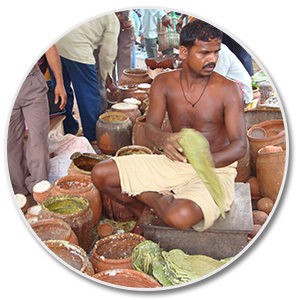
The food offered to Lord Jagannath is prepared in the historic Rosha Ghara, the world's largest traditional kitchen operating continuously for nearly nine centuries. Covering 32 rooms with 752 specialized earthen hearths (chulhas), over 1,000 hereditary cooks known as Suara Sevayats cook feasts for 25,000 to over 100,000 pilgrims daily:
Cooks place seven unglazed earthen pots (Kudua) vertically one on top of another over a single wood fire. Defying ordinary thermodynamics, the food in the topmost pot cooks first, while the bottom pot closest to the flames cooks last! Devotees revere this phenomenon as the direct grace of Goddess Mahalaxmi.
The kitchen strictly uses indigenous Indian vegetables: raw plantains, yellow pumpkin, sweet yam, colocasia, green papaya, and indigenous lentils. Onions, garlic, potatoes, tomatoes, and foreign spices are completely barred. Food is simmered exclusively in pure desi cow ghee, rock salt, and water drawn from sacred Ganga and Yamuna wells.
Tradition holds that Goddess Mahalaxmi personally cooks the offerings unseen; the human Suara cooks act merely as her physical instruments. If Goddess Mahalaxmi is ever displeased, a mysterious divine dog (Kutha Bira) is seen near the kitchen, requiring the entire batch to be discarded and buried in Koili Vaikuntha.
When the food is carried from the Rosha Ghara into the sanctum sanctorum or Bhogamandapa, it is technically termed Naivedya or Bhoga. It is consecrated with Vedic mantras and offered to Lord Jagannath upon the Ratnavedi.
However, the divine offering does not become Mahaprasad (Great Consecrated Nectar) until it is immediately brought to the shrine of Goddess Bimala (the supreme Shakti of Srikshetra situated within the inner courtyard). Only after Goddess Bimala accepts the sanctified food as the divine mother does it attain the exalted status of Mahaprasad.
According to the Skanda Purana, even a single grain of Mahaprasad frees the soul from the endless cycle of karmic bondage (Samsara).
The Sanskrit word Ananda signifies "divine bliss." In ancient and medieval India, where rigid caste laws and touch pollution governed daily life, Ananda Bazaar stood as a revolutionary beacon of human equality.
Within Ananda Bazaar, caste discrimination does not exist. Brahmins, kings, warriors, artisans, and untouchables sit side-by-side on the ground and eat from the exact same earthen pots.
By scriptural injunction, Mahaprasad can never be contaminated or made impure by the touch of any human being. Devotees may happily take food directly from one another's hands — an extraordinary social miracle preserving Lord Jagannath’s universal compassion.
The culinary offerings to Lord Jagannath are traditionally classified into two broad categories: Sankhudi Bhoga (steamed hot meals and curries) and Sukhila Bhoga (dry sweets, baked pastries, and confectioneries):
Puri is renowned across India as a paradise for traditional sweet lovers. No visit to Ananda Bazaar is complete without indulging in these signature treats:
Made by rolling refined wheat dough into delicate concentric layers, frying them in desi cow ghee, and soaking them briefly in fragrant sugar syrup. Crisp, light, and flaky, authentic Khaja remains fresh for up to 20 days without preservatives.
Centuries before modern confectioneries, Odisha Rasagola was offered to Goddess Mahalaxmi during Niladri Bije (when Lord Jagannath pacifies his consort with soft, melt-in-the-mouth, caramel-hued cottage cheese balls).
Odisha’s beloved roasted cheese cake. Fresh handmade cottage cheese is kneaded with sugar, cardamom, and cashews, wrapped in sal leaves, and slow-baked over wood coals until a caramelized, smoky golden crust forms.
Follow these tips to enjoy the freshest Mahaprasad feast in Ananda Bazaar:
Freshly cooked hot meals (Madhyanha Abhada) arrive in Ananda Bazaar around 1:00 PM to 3:30 PM daily following the midday dhupa. Dry sweets like Khaja and Pheni are available from morning until 9:30 PM.
Individual meal pots (containing rice, dalma, and besar) generally cost between ₹150 and ₹350. Full family feast pots (Subarna Kudua) range from ₹600 to ₹1,500. Pricing is transparent and reasonable.
Devotees sit cross-legged on clean traditional floor mats in designated dining sheds. Food is served on fresh green sal or banana leaves. Takeaway orders are packaged in natural unglazed clay pots (Kudua) wrapped in palm ropes.
After experiencing the divine sacred flavours of Ananda Bazaar, continue your culinary journey at Puri Holiday Resort on Chakratirtha Road. Our beachfront dining venues, Holiday Palms and Fusion, serve authentic coastal Odia delicacies, fresh Bay of Bengal seafood (Chilika crab, jumbo prawns), and multi-cuisine favorites.
Planning to take authentic Jagannath Temple Khaja back home for family and friends? Our front desk concierge coordinates directly with authorized heritage sweet-makers to deliver freshly packed, crisp temple Khaja boxes directly to your room prior to departure.
Common questions answered for pilgrims and food travelers:

PLEASE PROVIDE GOVT. APPROVED PHOTO IDENTITY CARD OF ALL ADULT PERSON AT THE TIME OF CHECKING IN